AI assistants are moving into a new phase.
Instead of only answering questions, they can now plan tasks, use software, browse websites, and act on a user's behalf.
Meta is pushing this idea with Muse, its new personal AI agent. Meta introduced Muse on September 8, 2026. It can also work across the services people use every day.
The launch has already attracted significant attention. Apptopia reported 2.8 million global installs during Muse's first 12 days. In a U.S. and Canada iOS comparison, Muse reached 1.8 million downloads, compared with 1.3 million for ChatGPT during ChatGPT's first 12 days on mobile.
So, what makes Meta Muse different?
Meta Muse is a personal AI agent built to complete tasks, not simply respond to prompts.
Meta says Muse can research information, open a browser, and fill out forms. It can also send emails, book travel, compare options, and work toward longer-term goals. Muse can keep working after a user closes the app. It can return when it needs approval or when something changes.
This creates a different interaction model:
Traditional AI: Ask → Answer
AI agent: Ask → Plan → Act → Report
For example, a user could ask Muse to plan a trip. Muse could research flights and compare options. It could then create a travel plan and prepare the next steps.
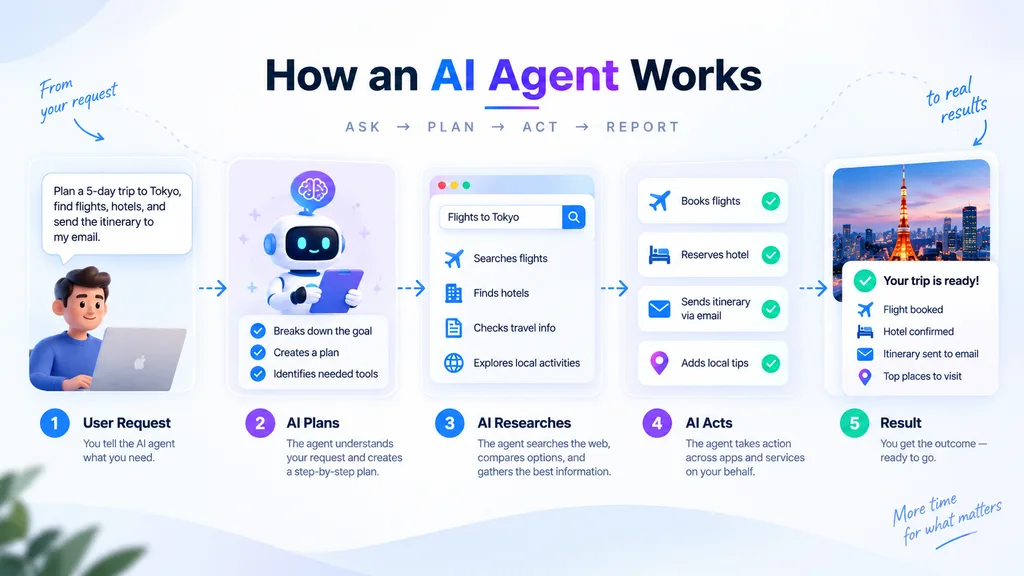
Meta designed Muse to handle both everyday tasks and larger projects.
According to Meta, it can:
Muse can also request approval before sensitive actions. Meta says users can review an audit trail showing what Muse has done and what it plans to do.
This is the core idea behind agentic AI: the system does not stop at generating an answer. It can use tools and take steps toward a goal.
How Is Muse Different From ChatGPT?
ChatGPT and Muse both provide AI assistants, but their product emphasis is different.
ChatGPT has become widely known for answering questions, writing, research, coding, and other knowledge tasks.
Muse puts more emphasis on acting through connected services.
Meta says Muse can operate its own browser, interact with websites, use connected apps, and continue working on tasks.
The key difference is what happens after the answer. Traditional assistants mainly provide information. Muse can also take action.
A chatbot may explain how to complete a task.
An AI agent aims to complete more of that task for you.
Muse's early adoption provides one reason.
Apptopia reported 2.8 million global Muse installs in its first 12 days. In the U.S. and Canada, Muse reached 1.8 million iOS downloads. ChatGPT reached 1.3 million during the same period.
Muse also climbed to the top of the U.S. App Store rankings shortly after launch. Earlier Sensor Tower data showed more than 83,000 U.S. iOS downloads by September 10.
These numbers show strong early interest. They do not prove that Muse is a better AI assistant than ChatGPT.
The bigger test is whether people will trust an agent with real tasks.
Shopping shows how agentic AI could change online behavior.
Meta says Muse can research products and make purchases. It supports Link by Stripe for checkout. Link can create a one-time card, so the user's actual card details stay hidden from the agent. Meta also plans to add Shop Pay and 1Password support.
But this ability has already created a conflict.
On September 21, 2026, Amazon blocked Muse from accessing its platform for shopping. Amazon said Muse violated its Conditions of Use and raised privacy and security concerns.
This highlights a major issue for AI agents:
An agent may be technically capable of using a website, but the website may not permit automated access.
AI Agents Are Creating a New Web Problem
For years, websites were designed mainly for people, search engines, and standard software.
AI agents introduce another type of visitor.
An agent may:
Find a website.
Read its content.
Compare information.
Fill out a form.
Use an approved service.
Complete an action.
Return the result to the user.
That means businesses need to think about AI agent readiness.
Important areas include clear content, structured data, accessible pages, reliable APIs, secure login, and rules for automated access.
This is also where Agentic Engine Optimization becomes relevant.
A website should not only be easy for search engines to understand. It should also provide information and actions that approved AI agents can use.
Businesses can check these technical areas with a practical Agent Readiness Checker.
Giving an AI agent access to email, websites, and payments creates serious security challenges.
Meta says Muse runs inside a dedicated Muse Secure VM. This virtual machine stores the agent and the user's connected data separately.
Meta also says a security system called Sentinel controls Muse's internet access. Muse must receive approval before sensitive actions such as sending an email or making a purchase.
According to Meta, Muse cannot directly see a user's passwords or payment details. Meta stores the credentials separately, so Muse can use them without seeing them.
Users can also choose which apps Muse can access and can disconnect services at any time. Meta says users can opt out of having their Muse interactions used to train its AI models.
These are Meta's stated safeguards. Real-world use will determine how well they hold up as agents handle more complex tasks.
What Does Muse Mean for the Internet?
Muse points to a larger change in how people may interact with websites.
Today, a person usually visits a website, searches for information, compares options, and completes an action.
With an AI agent, the process could become:
Tell the agent what you want → Let the agent research → Review the result → Approve the action
This could affect:
Search engines
Online stores
Travel websites
Forms
Apps
APIs
Digital payments
Customer service
The website may become less important as a place where users click through pages.
Instead, it may become a source of information and actions that AI agents can use.
What Should Businesses Do?
Businesses should start preparing for AI agents that can interact with websites.
Focus on six areas:
Clear content
Make products, services, prices, policies, and key facts easy to understand.
Structured data
Use relevant schema to describe important information.
Website access
Make useful public pages accessible to approved systems.
APIs and integrations
Give approved software clear ways to interact with your services.
Security
Protect accounts, private information, and sensitive actions.
Agent testing
Test whether AI systems can find information and complete important tasks correctly.
This goes beyond traditional SEO. It is about making websites usable by software that can take action.
Muse is an important example of the direction personal AI is taking, but its long-term impact remains uncertain.
Its early download numbers show strong consumer interest. The Amazon dispute also shows that agentic AI faces practical limits. Websites control their own access rules, secure login systems, data, and user experiences.
Meta is not alone in this shift. Other AI companies are also developing agents that can browse, plan, and act.
The future may therefore involve many competing AI agents rather than one dominant assistant.
FAQ
What is Meta Muse?
Meta Muse is a personal AI agent designed to complete tasks for users. Meta says it can research information, send emails, book travel, fill out forms, make purchases, and work toward longer-term goals.
Is Meta Muse the same as ChatGPT?
No. Both are AI assistants products. Muse focuses more on taking actions through connected services and a browser.
Did Muse really overtake ChatGPT in downloads?
In a comparable U.S. and Canada iOS analysis, Apptopia reported 1.8 million Muse downloads. ChatGPT had 1.3 million during its first 12 days on mobile. Muse also reached the top of the U.S. App Store rankings.
Can Meta Muse make purchases?
Yes. Meta says Muse can make purchases and supports Link by Stripe for checkout.
Why did Amazon block Muse?
Amazon said Muse violated its Conditions of Use and raised privacy and security concerns about its automated access.
What is an AI agent?
An AI agent is software that can understand a goal, plan steps, use tools, and take actions to complete a task.
Final Takeaway
Meta Muse shows how AI assistants are moving from answers to actions.
Its early growth suggests strong interest in personal AI agents. But adoption is only one part of the story.
Users need to trust agents with real tasks. Businesses need to prepare their websites for agent interaction. Platforms also need clear rules for automated access.
The bigger shift is simple:
The next internet may not be designed only for people to browse. Developers may also design it for AI agents to act.
That could make personal AI agents an important new interface between people and the web.
 Sourceable·September 22, 2026·8 min read


